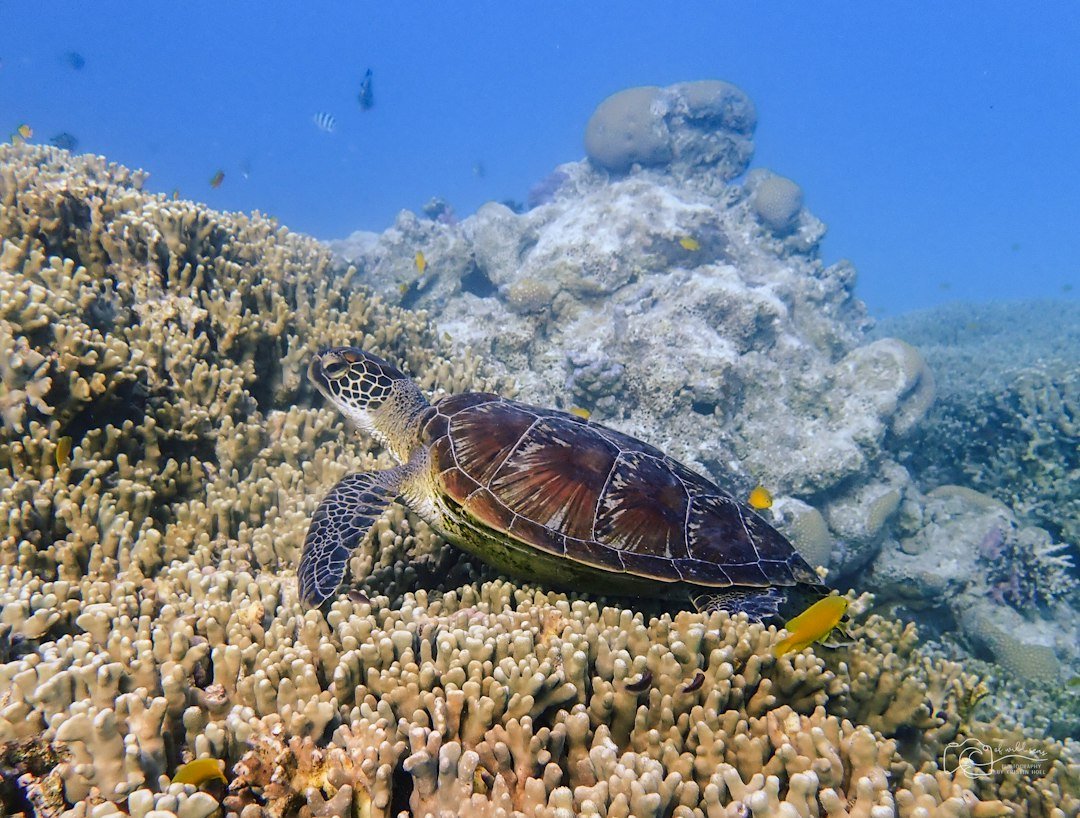
A common misconception is that getting a close turtle photo requires swimming straight at it. It does not. Learning how to photograph turtles underwater without disturbing them means letting the turtle control the distance, then using position, buoyancy, and lens choice to make the frame work. Keep it calm. The best answer to how to photograph turtles underwater is usually to settle near its route and wait rather than pursue it, corner it, or ask a buddy to herd it toward your camera.
How to photograph turtles underwater without disturbing them
Start by treating the turtle as wildlife, not a cooperative model. Give it room. Local marine-park rules or dive-operator briefings may set a required distance, so follow the most protective rule at your site. If no number is given, stay far enough away that the turtle continues feeding, resting, or cruising without changing direction because of you.
Approach from the side, never head-on, and do not hover directly above it. A turtle needs a clear route. Swimming into its path can make it stop, turn, dive away, or surface sooner than it planned. That is your cue to back off, even if the shot looked nearly perfect.
Good buoyancy is the real close-up tool. Before moving toward any turtle, stop over clear water or a sand patch and check that you can hold position without sculling your hands, kicking constantly, or dropping toward coral. Stay still. A drifting photographer can damage the reef and force an animal away in the same few seconds.
Never touch a turtle, hold onto its shell, feed it, or block it from a cleaning station, reef crevice, or the surface. These actions are not photography techniques. They can alter behavior, breach local rules, and put you too close to an animal that may react defensively. Keep your hands to yourself.
Read the turtle before raising the camera
A relaxed turtle often moves at an even pace, feeds with small head movements, or rests with its flippers loose. Watch first. If it keeps doing what it was doing while you remain still, you may have an opportunity to compose a photo without closing the gap.
Signs that you are too close include a sudden change of direction, faster flipper strokes, a tucked head, repeated glances toward you, or an immediate retreat into cover. One sign is enough. Slowly increase distance and let the animal leave if it chooses. Do not follow for another attempt.
Surface-bound turtles need extra care because they must breathe. Never position yourself between a turtle and open water above it, even if the light makes that angle tempting. Leave the vertical route clear. A thoughtful image is never worth making an animal alter a basic behavior.
Cleaning stations deserve the same restraint. Fish may remove algae or parasites from a turtle at these spots, and a hovering diver can interrupt the interaction. Stay farther back than you think. If your presence changes the turtle’s position or sends cleaner fish away, move on.
Set up your camera before the encounter
Fumbling with controls makes people chase wildlife. Prepare early. Set your camera while descending, during a quiet section of the dive, or before entering a known turtle area. That leaves you free to observe rather than rush.
For a turtle cruising in sunlit water, a useful starting point is a shutter speed around 1/250 second, an aperture near f/8 on many compact or mirrorless setups, and ISO adjusted for the available light. Check your results. Faster shutter speeds help keep flipper movement sharp, while a slightly wider aperture may be needed in darker water.
Use continuous autofocus if your camera tracks reliably underwater, then place the focus point around the eye or head. The eye matters. If your system struggles to lock on, pre-focus at the expected distance and wait for the turtle to enter that zone instead of pumping the shutter while moving closer.
A wide-angle lens is usually the respectful choice for a full turtle and its habitat because it rewards careful positioning rather than long pursuit. A close-focusing wide lens can show shell texture, reef, and blue water in one frame when the turtle naturally passes nearby. Do not force it. Macro gear works better for details only when the turtle is already close and unbothered.
Strobes can restore color, but avoid blasting light directly into a turtle’s face at close range. Angle strobes outward and slightly away from the head, especially for a side profile. Start low. In clear, shallow water, ambient light often gives a more natural result and lets you simplify the encounter.
Video lights need similar restraint. Do not shine a bright beam into the animal’s eyes, particularly during a night dive or when a turtle is resting under a ledge. Use a low, broad light aimed at the scene rather than the face, or skip the shot if you cannot light it without obvious disturbance.
Use position instead of pursuit
The strongest turtle photos usually come from getting low, finding clean water behind the subject, and waiting for a natural approach. Think ahead. A slightly upward camera angle can separate the turtle from a busy reef and include blue water, while a side angle often shows the shell pattern and flipper shape clearly.
Sun position changes everything. With the sun behind you, the shell often has more even color and simpler exposure. With the sun in front, you can make a silhouette or sunburst image, but expose carefully and avoid drifting into the turtle’s route while trying to line it up.
Keep fins well away from the bottom. Sand clouds can ruin a photo and may settle on nearby coral. On a reef, use a stable horizontal trim and small fin movements, then stop moving before you press the shutter. Quiet divers get better chances.
A simple field sequence
- Spot the turtle and pause at your current distance. Do not immediately swim toward it.
- Check its direction, feeding area, resting place, and likely route to open water.
- Set exposure, focus mode, and strobe power before narrowing the distance.
- Move slowly to the side or settle ahead of its path with plenty of clearance.
- Hold neutral buoyancy and wait for the turtle to choose whether it continues nearby.
- Take a short burst only when the composition is ready, then lower the camera and reassess its behavior.
- Back away after the frame. One clean photo is enough.
This sequence prevents a common mistake: taking dozens of rushed images while the turtle becomes increasingly alert. Slow down. If the animal changes course, your encounter is over and that is fine.
Choose the shot that fits the encounter
You do not need a shell-filling portrait every time. A wider environmental frame can be more interesting because it shows where the turtle was feeding or resting, while also allowing you to maintain a comfortable distance. Include habitat. Seagrass, reef contours, and open blue water can give the image scale without crowding the subject.
When a turtle is grazing, frame the head slightly off-center and leave space in the direction it faces. When it is swimming, leave room ahead of the animal rather than behind it. This makes the image feel less cramped and often matches its natural movement through the frame.
If visibility is poor, resist the urge to close distance aggressively. Poor visibility limits contrast and autofocus performance, but crowding wildlife will not solve either problem. Shoot a wider scene, look for a cleaner background, or save the close composition for another dive.
FAQ
How close can I get to a turtle underwater?
Use the distance required by local rules or your operator, and increase it whenever the turtle changes behavior because of you. Give it space. A turtle that continues calmly is more useful than a close turtle that is trying to leave.
Should I use flash for turtle photography?
Flash can help restore color at depth, especially on the shell and reef, but keep strobes low-powered and angled away from the eyes. Use restraint. Ambient light may be the better option in shallow, clear water or if your only angle puts the strobe close to the face.
What lens is best for underwater turtle photos?
A wide-angle or close-focusing wide-angle lens is the most flexible option for whole-animal and habitat images. It rewards good positioning. A longer lens can work in clear water, but it does not make it acceptable to track or pressure the turtle for a tighter frame.
Can I photograph turtles while they sleep?
You can photograph a resting turtle only if you can do so without touching the reef, blocking its exit, or shining harsh light into its face. Keep it brief. During night dives, limit light exposure and follow the wildlife guidance from your certified instructor or dive operator.
Related posts
This article is for general informational purposes only and is not dive training or medical advice. Always train with a certified instructor and consult a doctor before diving if you have any health concerns. Gear specs, pricing, site conditions, and operator schedules change, so verify current details directly with the manufacturer or dive operator.
Disclosure: This post may contain affiliate links. If you click through and make a purchase, we may earn a commission at no extra cost to you. We only recommend gear we’ve researched or genuinely believe in.